
The commencement of Eid al-Fitr has been officially declared.
Eid al-Fitr is a globally celebrated festival by Muslims to signify the conclusion of Ramadan, the month of fasting from dawn to dusk. The festival initiates on the first day of Shawwal, the tenth month in the Islamic lunar calendar, subsequent to the sighting of the new crescent moon.
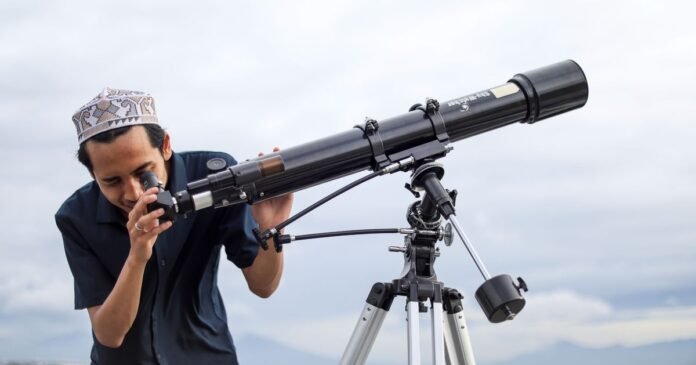
Saudi Arabia has affirmed that Eid al-Fitr will occur on Friday, March 20, as the crescent moon was not spotted in the kingdom during the evening. Religious scholars conducted sky observations post-Maghrib prayer to ascertain the start of the festivities.
Although Saudi Arabia is typically regarded as the standard for Eid dates due to its status as the birthplace of Islam, other countries follow their own protocols. For instance, Morocco employs its own national moon-sighting system, and certain Muslim communities, such as those in the UK, may opt to adhere to Morocco’s calendar instead.
The United Arab Emirates previously announced that federal government employees will enjoy a public holiday from Thursday, March 19, to Sunday, March 22, with work resuming on Monday, March 23.
Authorities in the UAE have mandated that Eid al-Fitr prayers must be conducted exclusively inside mosques, prohibiting gatherings in prayer grounds and open areas as a precautionary safety measure amid escalated regional tensions linked to the US-Israeli conflict with Iran.
In alignment with other Gulf nations following Saudi Arabia’s announcement, Qatar has verified that Eid al-Fitr will be celebrated on Friday, March 20. The declaration was made by Qatar’s Ministry of Awqaf and Islamic Affairs.
The Crescent Sighting Committee at the Ministry of Endowments and Islamic Affairs in Qatar announced that the crescent moon of Shawwal was not sighted, confirming that Friday, March 20, 2026, will mark the commencement of the blessed Eid Al Fitr in Qatar.
Eid al-Fitr is observed on the first day of Shawwal, the tenth month in the Islamic calendar, following the completion of Ramadan, where Muslims fast. The sighting of the new crescent moon heralds the start of Shawwal and the festivities of Eid.
A significant portion of Muslims adhere to their local or national moon-sighting systems, potentially leading to Eid celebrations occurring a day later.
Many Muslims worldwide rely on Saudi Arabia’s announcement for the initiation of Eid al-Fitr.
The UAE Council for Fatwa recently clarified the procedures to be followed if Eid al-Fitr coincides with a Friday, addressing public queries regarding prayer obligations. The council emphasized that both the Eid prayer and the Friday congregational prayer should be performed at their designated times. It highlighted that the majority scholarly view asserts that attending Eid prayer does not substitute the obligation of Friday prayer, which remains mandatory.
The significance of the moon in Eid al-Fitr is pivotal as the festival marks the end of Ramadan upon the sighting of the new crescent. Muslims fast throughout Ramadan, and the appearance of the Shawwal crescent signifies the conclusion of fasting and the commencement of celebrations.
Given the Islamic calendar’s dependence on the lunar cycle, the exact date of Eid varies depending on moon sightings, explaining why it falls on a different day each year.
Earlier today, a prominent astronomer in Saudi Arabia deemed the likelihood of sighting the new crescent moon over Saudi Arabia as “impossible” despite technological aids.
Chief Astronomer Abdullah Al Khudairi stated, “The crescent moon will set this evening 30 minutes before the sun, and it will not be possible to observe it.”
Saudi Arabia has verified that Eid al-Fitr will happen on Friday, as the Shawwal crescent moon was not observed in any part of the kingdom post-sunset.
The Holy Mosques reported the sunset in the eastern region of Saudi Arabia without any sightings of the crescent moon, indicating, “Sunset in the eastern region of the Kingdom with no reports of sighting.”
Observatories in Saudi Arabia are gearing up to commence the sighting of the crescent moon, with astronomers from Al Maj’mah University stationed at Sudair and Tumair to search for the crescent.
Various moon-sighting gatherings have been scheduled across the UK on Thursday evening, with communities expected to start sky observations for the crescent moon around sunset at approximately 6:05 pm.
Planned moon-sighting locations include:
Additional public sighting locations have been detailed online, encouraging observers to update and share sightings.
Many Muslims are currently observing fasts from dawn to sunset, with fasting commencing around 4:30 am and breaking shortly after 6 pm, lasting approximately 13.5 hours.
Throughout this period, they abstain from food and drink while refraining from negative behaviors like swearing and arguments. Ramadan embodies a time of spiritual contemplation, self-discipline, and empathy, urging Muslims to reflect on those deprived of daily essentials like food and drink.
Numerous Muslims also engage in additional congregational prayers at mosques during Ramadan.
If the crescent moon