
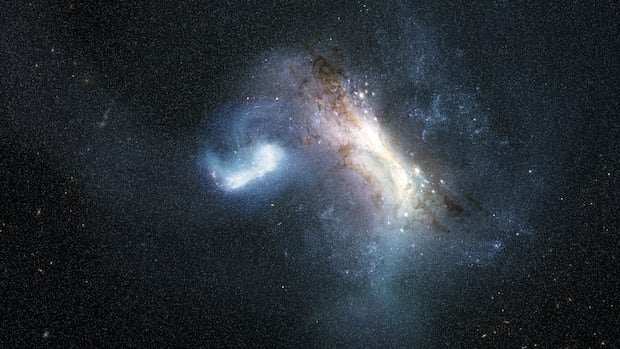

A recent study has shed light on the complex evolution of the Milky Way galaxy, our cosmic home featuring billions of stars, including our sun. Researchers have uncovered evidence of a significant event in the Milky Way’s early history – the absorption of a smaller galaxy approximately 11.8 billion years ago when the universe was still in its infancy. This marks the earliest galactic merger for the Milky Way, highlighting its growth through not only internal star formation but also by merging with smaller galaxies drawn into its gravitational pull.
The assimilated galaxy was classified as a dwarf galaxy, smaller than the Milky Way. Scientists estimate it contained stars equivalent to 500 million solar masses at the time of the merger, about a quarter of the Milky Way’s size then. By studying stellar clusters using the Hubble and Gaia telescopes, researchers analyzed the age, chemical composition, and trajectory of stars within a 20,000-light-year span at the Milky Way’s core.
The merger, occurring roughly two billion years after the Big Bang, integrated these stars into the Milky Way. The dwarf galaxy, named Low-energy-Kraken-Heracles (LKH), signifies a critical discovery in understanding the Milky Way’s early transitions, according to lead researcher Davide Massari.
Contrary to previous debates, the study suggests that this merger significantly enriched the Milky Way with stars, interstellar gas fueling star formation, and dark matter. Massari described the merger as “peaceful” in terms of star interactions but “explosive” regarding gas collisions, likely triggering star formation. Moreover, the Milky Way has encountered two other major mergers in its history, influencing the formation of our solar system and Earth, emphasizing the significance of unraveling the galaxy’s past.