
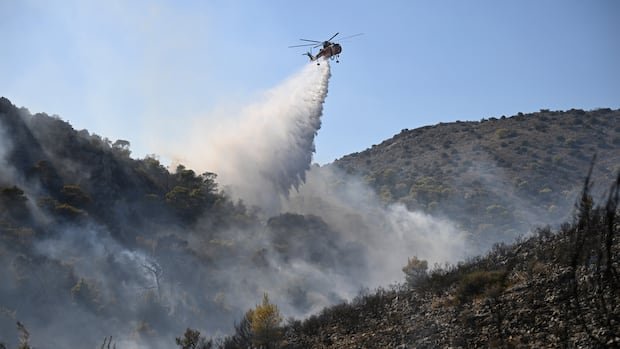

Firefighters engaged in combatting an extensive wildfire that ravaged a nature reserve in eastern Belgium and another on a Greek island near Athens, resulting in two fatalities on Sunday due to hot and dry conditions escalating fires across Europe.
The wildfire in eastern Belgium consumed roughly 30 square kilometers in the High Fens (Hautes Fagnes), marking one of the nation’s severe wildfires in recent memory. Approximately 600 residents in the nearby municipalities of Waimes and Bütgenbach in Liège province, close to the German border, were instructed to evacuate as winds changed direction, spreading smoke throughout the region. Authorities recommended tourists to leave the area, offering a nearby gymnasium for evacuees.
Hervé Jamar, the provincial governor of Liège, announced on Sunday that more than 250 emergency responders were dispatched, including over 100 Belgian and German firefighters, along with police, military personnel, and civil protection teams. Belgium’s federal police and the Netherlands also deployed firefighting helicopters.
In Greece, the coast guard confirmed the death of an elderly couple outside their residence on the island of Salamina, situated west of Athens, near the origin of a fire. Over 500 individuals were rescued from the island. The fire erupted during Greece’s peak summer vacation weekend around the Assumption holiday on August 15, drawing many Athenians to nearby islands like Salamina, easily accessible from Piraeus, the capital’s main port.
Reports indicated property damages, with five individuals receiving medical attention at a health clinic. The firefighting efforts consisted of around 192 firefighters, 14 aircraft and helicopters, volunteer teams, and municipal water carriers to contain the infernos. Coast guard and firefighting vessels were dispatched to the island, preparing for potential sea evacuations from endangered coastal zones.
Salamina faced a high wildfire risk warning on Sunday, and the cause of the fires remained undisclosed. The ongoing blaze in Belgium has exceeded a 2011 fire that consumed nearly 14 square kilometers in the same vicinity, previously the country’s largest recorded wildfire according to the European Forest Fire Information System.
Nicolas Yernaux, a spokesperson for the Public Service of Wallonia, highlighted worsening conditions this time, emphasizing extremely dry soil as a critical factor. René Dahmen, the chief engineer at the Department of Nature and Forests, mentioned challenges in reaching the fire’s spreading area, particularly on the eastern flank.
Interior Minister Bernard Quintin confirmed successful containment efforts to prevent the fire from advancing towards the west and Germany’s Monschau. Local German authorities cautioned that the fire was approximately 1.5 kilometers away from the border. Farmers from both Belgium and Germany assisted by filling tanker trucks from a nearby lake and heading towards the fire zone to support firefighters.
Belgium activated the European Union’s civil protection mechanism to receive aid from other nations, as confirmed by Hadja Lahbib, the EU’s crisis management commissioner. Sweden dispatched two water-bombing aircraft, while three helicopters – two from the Netherlands and one from the Czech Republic – were also mobilized.
The wildfires emerged following weeks of uncommonly hot and dry weather, complicating containment efforts in the High Fens due to its mix of heathland and peat bogs. Belgium experienced another period of intense heat, with temperatures reaching approximately 37 degrees Celsius in some regions on Friday.
In France, firefighters confronted a wildfire in a pine forest in the Landes region without significant flare-ups overnight, with an estimated burn area of 17 square kilometers and evacuation of about 650 residents. The UK deployed emergency crews combating 14 wildfires in South Wales, supported by military personnel, as officials cautioned about continued wildfire risks despite the easing heat wave.
In the UK, more than a dozen residences were devastated in the West Midlands, with the highest recorded temperature of the year at 38.1 degrees Celsius on Thursday. German firefighters made substantial progress against a wildfire in the Hürtgen Forest, enabling about 2,000 evacuated Gey residents to return home on Saturday, with no active flames reported on Sunday, and a secured perimeter established to prevent further spread.