
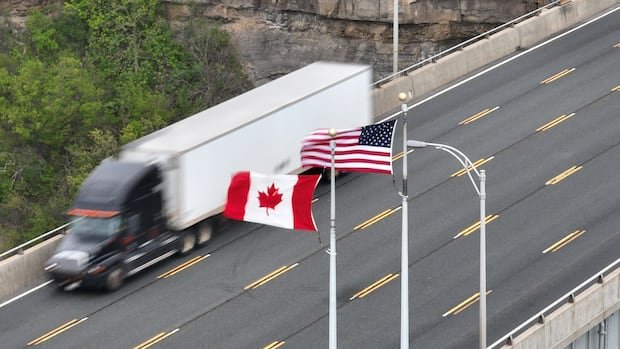

As negotiations to avoid additional U.S. tariffs progress, a recent analysis cautions that the collapse of the Canada-U.S.-Mexico Agreement (CUSMA) could result in significant job losses and economic repercussions on both sides of the border. The study, commissioned by the Canadian American Business Council and conducted by Oxford Economics, explored the potential outcomes of the ongoing trade discussions between the U.S. and Canada.
Three scenarios were considered: maintaining the current tariff status quo, a scenario where CUSMA disintegrates, and a successful renegotiation leading to an improved trading relationship. The report projected that if CUSMA were to dissolve, approximately 214,000 jobs in the U.S. and 102,000 in Canada would be at risk compared to the status quo. Conversely, successful renegotiation could result in the creation of 137,000 jobs in the U.S. and 98,000 jobs in Canada.
Beth Burke, CEO of the Canadian American Business Council, emphasized the significance of the U.S.-Canada trade relationship for both countries’ prosperity, noting the potential impact on job security and economic stability. The report also forecasted substantial GDP losses for the U.S. ($1.04 trillion US) and Canada ($271 billion Cdn) by 2035 in the event of a breakdown, with inflation acceleration and constrained real disposable income growth expected.
In a breakdown scenario, manufacturing sectors in the U.S., especially in states like Iowa, Michigan, Kentucky, and Alabama, would suffer, while Quebec and Ontario in Canada would face significant challenges due to their reliance on manufacturing. As the deadline for new tariffs on Canadian products nears, officials are actively working to reach a trade agreement to avert further economic strain.
Trade Minister Dominic LeBlanc’s ongoing discussions with U.S. Trade Representative Jamieson Greer aim to present a potential deal to President Donald Trump before the tariff deadline. Burke expressed optimism about the negotiations but highlighted the necessity of concessions from both sides for a mutually beneficial agreement.
The threat of new tariffs stemmed from concerns over various trade issues, including alleged dairy product discrimination, auto tariffs, and alcohol bans. Negotiators are exploring solutions across strategic sectors to reach a resolution. If an agreement is not reached, the new tariffs are expected to impact manufacturers in central Canada the most.
A recent report by Oxford Economics indicated that cement, concrete, and paper product manufacturers would be significantly affected, with Ontario, New Brunswick, and Quebec facing the most substantial impact due to their sector dependence. Provinces like Saskatchewan, Alberta, and Newfoundland and Labrador are projected to be less affected by the potential tariffs.