
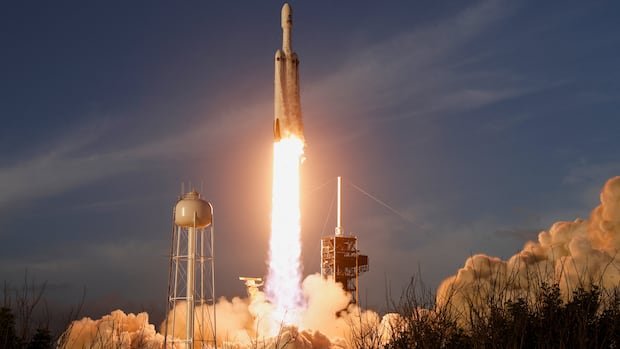

NASA embarked on a groundbreaking mission on Sunday by launching the Nancy Grace Roman Space Telescope, a reimagined spy satellite aimed at unraveling key mysteries in astrophysics and cosmology. The approximately $4 billion project took flight from NASA’s Kennedy Space Center in Cape Canaveral, Fla., aboard a SpaceX Falcon Heavy rocket under clear skies at sunrise. The telescope’s primary objective, spanning a planned five-year mission but potentially extended by five additional years due to fuel reserves, involves exploring enigmatic phenomena such as dark energy, dark matter, gravitational effects on a grand scale, and the quest for exoplanets, planets beyond our solar system.
The Nancy Grace Roman Space Telescope will position itself in orbit beyond the moon to delve into cosmic puzzles. Originally intended for a spy satellite initiative under the National Reconnaissance Office, the telescope was repurposed by NASA in 2012 for cosmic exploration following the termination of the original program due to budgetary issues.
Named after NASA’s inaugural chief astronomer, who is also known as the “mother of the Hubble Space Telescope,” the Roman telescope will journey towards Lagrange Point 2, located approximately 1.6 million kilometers from Earth. Over the next 90 days, mission scientists will commission and prepare the telescope for scientific operations, with the first high-resolution images expected to be transmitted before the winter holidays.
NASA Administrator Jared Isaacman expressed confidence that the Roman Space Telescope, like its predecessors such as the James Webb Space Telescope and the Hubble Space Telescope, will become a household name synonymous with groundbreaking discoveries. The Roman telescope is not only comparable to the Hubble in sensitivity and vision sharpness but offers a swifter survey of the cosmos. While Hubble would require a century to survey the Milky Way galaxy, Roman can accomplish the task in just a month.
In a bid to comprehend the universe’s enigmatic components, dark energy and dark matter, the Roman telescope will create an extensive 3D map of the universe, covering more than two billion galaxies during its primary survey expected to last over a year. The telescope’s exploration will also involve one of the most thorough searches for exoplanets ever conducted, potentially unveiling thousands of new exoplanets and providing a statistical overview of planetary systems akin to our own.
With the launch of the Nancy Grace Roman Space Telescope coming ahead of schedule and overcoming funding challenges, NASA is poised to delve into uncharted cosmic territories, shedding light on fundamental cosmic mysteries.