
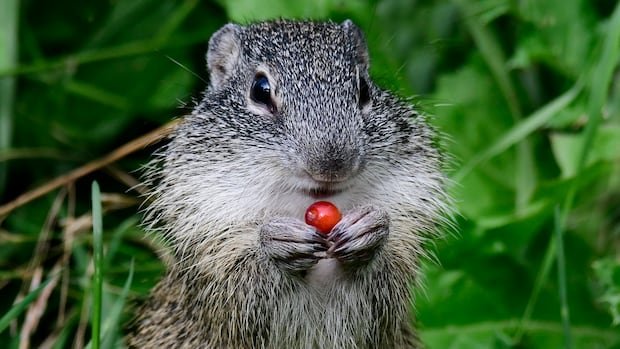

Scientists in Alberta are urging residents to be on the lookout for a rare rodent species. The secretive Franklin’s ground squirrel is the focus of a wildlife research initiative led by biologist Jess Haines in collaboration with Nature Alberta. The project was initiated after local naturalists observed a decline in the squirrel’s population and realized no prior research efforts were being made.
The primary goal of the project is to confirm the population decline of Franklin’s ground squirrels, currently classified as “undetermined” by the Alberta government due to insufficient data. Haines aims to gather comprehensive data on the squirrel’s population trends to advocate for changing its status to “at-risk.” Unlike Richardson’s ground squirrels, which flourish in human-altered environments, Franklin’s ground squirrels rely strictly on natural habitats with dense vegetation and forested areas.
The conversion of natural lands for agricultural and urban purposes has directly contributed to the decline of Franklin’s ground squirrels according to Haines. They were once widespread across central Alberta, reaching into the southern boreal region and foothills, but are now limited to a few remaining populations. Notable locations where Franklin’s ground squirrels can still be found include Wabamun Lake Provincial Park, Pigeon Lake, Dry Island Buffalo Jump Provincial Park, Rochon Sands Provincial Park, and Buffalo Lake.
Unlike other ground squirrel species that form large visible colonies, Franklin’s ground squirrels naturally exist in small numbers and low densities. Their vulnerability to disappearing from an area due to their limited population size makes them particularly sensitive to habitat changes.
The research project led by Haines and her team involves extensive fieldwork to study Franklin’s ground squirrels, including capturing, collecting data, and releasing them back into the wild. The public is encouraged to contribute historical and current squirrel sightings through the iNaturalist platform, facilitating the tracking of their distribution in the province.
The project, which remains ongoing without a specified end date, is currently focused on gaining a comprehensive understanding of the squirrel population across Alberta. The team plans to address more specific concerns in the future, based on the collected data. Myrna Pearman from the Red Deer River Naturalists expressed her affection for the squirrels and highlighted the importance of their conservation efforts.
With 14 squirrel species in Alberta, including five ground squirrel species, the Franklin’s ground squirrel stands out with its unique habitat preferences and physical characteristics. Presently, no squirrel species are considered at-risk in Alberta.