
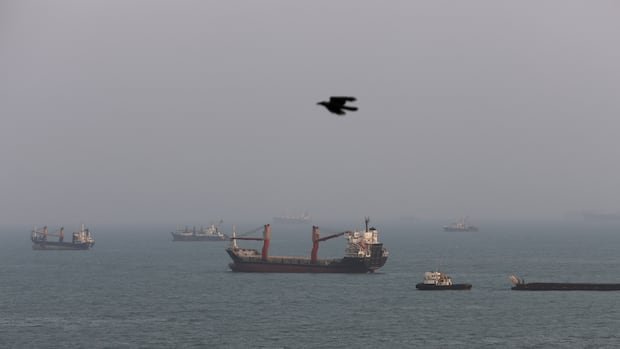

U.S. President Donald Trump announced on Tuesday that there were no ongoing discussions with Iran and reaffirmed that the Strait of Hormuz was operational, going against Iran’s claim that the crucial water passage was closed to maritime traffic.
The diminishing chances of reaching a resolution to the nearly six-month conflict led to a rise in oil prices once more on Tuesday. Stock markets experienced a decline, while borrowing costs for major economies, including the U.S., reached multi-decade highs amid concerns about long-term inflation and fiscal repercussions stemming from the crisis.
Following the expiration of a temporary ceasefire agreement on Monday, a senior Iranian official disclosed that Iran was transitioning to a “fully offensive” military stance due to the diplomatic deadlock. However, there were no reports of fresh hostilities from either side on Tuesday.
Trump took to Truth Social to state, “There are no talks or conversations underway, or planned, with the Islamic Republic of Iran.” He asserted that the Naval Blockade was still in effect and that the Strait of Hormuz was functioning normally with all water mines deactivated.
On a positive note, Jared Kushner, Trump’s son-in-law and special envoy, had expressed optimism on Monday, indicating that talks with Iran were ongoing and more robust than ever before.
The conflict initiated by joint U.S.-Israeli strikes on Iran has evolved into a stalemate, with Iran persisting in threatening shipping in the strait while Washington has warned of potential renewed attacks if negotiations fail to produce a lasting settlement. One of the primary U.S. objectives is to prevent Iran from obtaining a nuclear weapon, a challenging task that experts believe necessitates the removal of enriched uranium suspected to be concealed at previously targeted Iranian sites.
Despite Trump’s claims of an improving situation in the Gulf, disruptions to shipping persisted among various countries. The United Arab Emirates’ Defence Ministry reported the detection of two ballistic missiles launched from Iran, marking the first such incident since an attack on the Fujairah port on May 4. The UAE later stated that the missiles were aimed at maritime traffic, with both projectiles landing in the sea. Iran refuted these allegations, labeling the accusations as baseless.
The UAE Foreign Ministry declared the suspension of all trade activities, exchanges, and financial transactions with Iran until further notice, citing escalating tensions that jeopardize regional and global peace and security. Direct cargo shipping between the UAE and Iran had only resumed in late June via Dubai’s Jebel Ali Port after being halted in early March at the onset of the conflict.
Reports surfaced on Tuesday from the United Kingdom Maritime Trade Operations detailing an incident where a vessel transiting through the Strait of Hormuz was hit by an unknown projectile, resulting in engine room damage and casualties among the crew. The Omani Coast Guard was providing assistance to the affected crew members, with no immediate response from Tehran.
Iranian negotiator Mohammad Baqer Qalibaf emphasized that the strait would remain closed until the U.S. fulfilled the conditions outlined in an interim agreement inked with Iran in June. These conditions include lifting the blockade on Iranian ports, removing oil sanctions, releasing frozen Iranian assets, and ceasing threats and military actions on all fronts. The agreement, which aimed for an immediate cessation of military operations, quickly collapsed due to disputes over control of the vital Strait of Hormuz.
Iran expressed readiness for dialogue with the U.S. but emphasized that negotiations should not be mistaken for capitulation, as highlighted by Mohammad Mokhber, an adviser to Iran’s supreme leader. Mokhber stressed that military pressure and sanctions would not weaken Iran’s resolve, asserting the country’s commitment to defending its security, dignity, and allies while avoiding war.
As the conflict persists, concerns remain among Iranian officials about the potential for increased economic hardships and social unrest due to additional punitive measures. The toll of the conflict has been substantial, with thousands of casualties primarily in Iran and Lebanon. Iran has launched attacks on U.S. military installations and infrastructure in several countries in the region.
The conflict has significantly impacted oil prices, with Brent crude futures surging to $126 US per barrel at one point, a 75% increase from prewar levels. On Tuesday, Brent crude futures closed slightly higher at just over $91 US per barrel. Amidst ongoing sanctions actions, a U.S. administration official reiterated the possibility of further economic measures against Iran in the coming months.