
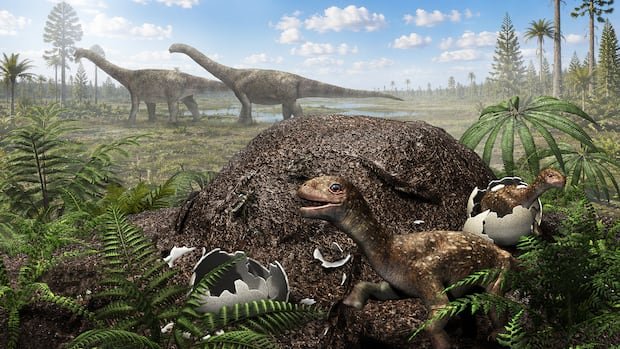

Fossilized eggshells from some of the largest dinosaurs ever discovered have been unearthed in a surprisingly cool region distant from the equator. Despite their immense size, these titanosaurs couldn’t rely on brooding their volleyball-sized eggs to maintain warmth, as their size would have resulted in a disastrous outcome, according to University of Calgary paleontologist Darla Zelenitsky.
A recent study led by Zelenitsky and an international team of researchers has delved into the microscopic features of these eggshells, revealing the innovative incubation method employed by titanosaurs. By examining the eggshell pores, the team suggests that these colossal dinosaurs likely adopted a strategy akin to modern crocodiles, burying their eggs in warm piles of decomposing vegetation to facilitate incubation.
Titanosaurs, colossal herbivorous dinosaurs characterized by their long necks and tails, roamed the Earth millions of years ago, weighing up to 75 tonnes, comparable to half the mass of a blue whale. These dinosaurs have been linked to volleyball-sized fossil eggs known as Fusioolithus, previously abundant in warmer climates. In a surprising discovery, fragments of Fusioolithus eggshells were found in the Chorrillo Formation in Argentina, dating back to the Late Cretaceous period, shortly before the dinosaur extinction.
The Chorrillo Formation, once situated at a similar latitude to Red Deer, Alta., boasted a climate resembling present-day New York City, showcasing a diverse ecosystem teeming with titanosaurs like Nullotitan glaciaris, smaller herbivores, carnivorous megaraptors, and various other fauna like crocodiles, snakes, turtles, and mammals. The revelation of titanosaur eggs in this region challenges previous assumptions about their nesting habits and adaptation to varying environments.
Researchers emphasize the importance of maintaining optimal egg warmth for successful embryo development and hatching, a challenging task for dinosaur species of varying sizes. While smaller feathered dinosaurs likely brooded their eggs for warmth, titanosaurs resorted to burying their eggs to prevent crushing. This burial method, shared with modern crocodiles and megapode birds, involves utilizing the heat generated by decomposing organic matter to facilitate incubation.
The research underscores the remarkable adaptability of dinosaurs, showcasing their ability to thrive and reproduce in diverse environments, even in higher latitudes where resources are scarcer. The findings shed light on the intricate nesting strategies employed by titanosaurs and raise questions about the diversity of these behaviors across different time periods and regions. Exciting avenues for further exploration and comprehensive studies on titanosaur nesting strategies are proposed to unravel more mysteries surrounding these ancient giants.