
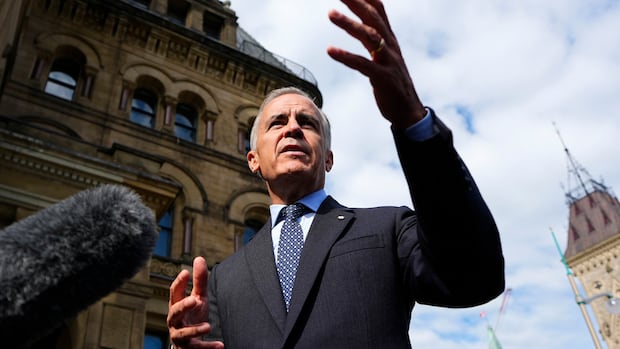

With just hours remaining before Canada imposes counter-tariffs on $27.6 billion in goods from the U.S., no negotiations are planned between the two nations.
The Prime Minister’s Office has informed CBC News that there are no scheduled communications between Prime Minister Mark Carney and U.S. President Donald Trump on Monday, nor are there any intentions for Canadian trade representatives to reconvene ahead of the Tuesday deadline at 12:01 a.m. ET.
This is the moment when counter-tariffs will affect more than 700 American products.
These tariffs, which vary between 15 and 50 percent, are a reciprocal response to Trump’s recent imposition of 50 percent tariffs on Canadian goods after trade discussions fell apart just before an agreement was reached.
The most significant tariffs are aimed at sectors that have been particularly affected by U.S. tariffs, including steel, dairy, and lumber products.
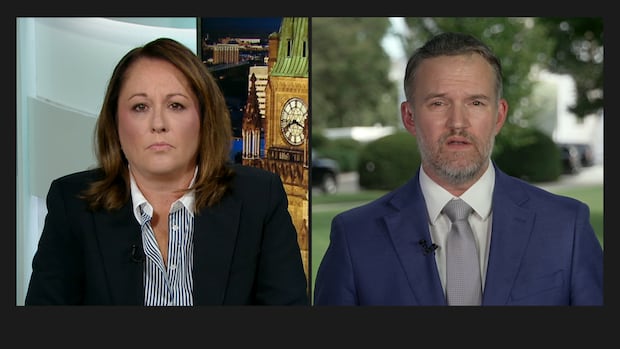
In an exclusive interview with CBC News, U.S. Trade Representative Jamieson Greer contested Canada’s reasons for the breakdown in trade talks, stating to CBC News chief political correspondent Rosemary Barton that there are currently no ‘open channels’ for both parties to return to negotiations.
In a conversation with CBC News last week, U.S. Trade Representative Jamieson Greer cautioned about potential retaliation from the U.S., indicating that the U.S. might contemplate bans on Canadian imports.
“If Canada retaliates further, we will not simply sit by and accept that. Our stance is clear: ‘Do not retaliate,'” he remarked to CBC News chief political correspondent Rosemary Barton.
When asked by CBC News on Monday regarding Canada’s decision to retaliate, former Prime Minister Jean Chrétien expressed his support for the counter-tariffs, suggesting that Canada may need to consider additional measures.
He noted, “The U.S. has excluded oil, gas, electricity, and potash from tariffs. Why? Because they rely heavily on these. So, perhaps at some point, we might need to implement an export tax.”
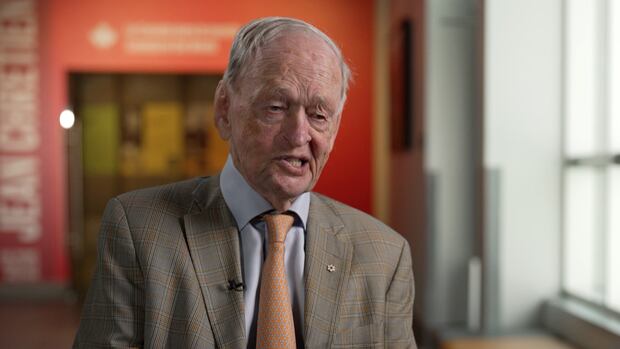
Former Prime Minister Jean Chrétien tells CBC News chief correspondent Adrienne Arsenault that Canada’s counter-tariffs on the U.S. are a ‘good move’ and it may be necessary to take them further.
Conservatives urge Carney to be ‘transparent’
The Conservative Party is calling on the federal government to be “transparent” with Canadians regarding the effects of the retaliatory tariffs on households and businesses.
“The Canadian public deserves to know the facts and a plan,” Conservative Leader Pierre Poilievre stated at a news conference in Regina on Monday. “The best way to ensure everyone is united and moving in the same direction is by being transparent about costs, decisions, and the way forward.”
Poilievre reiterated his demand for the government to disclose details about the Canada-U.S. trade agreement, which fell apart at the last minute last month.
Canadians “should have the opportunity to see it so they can evaluate what we are advocating for and what we are opposing,” he added.
The federal government has yet to provide specifics on the expected impact of the retaliatory tariffs in Canada, although it has announced $7.5 billion in support to assist workers and businesses cope with the trade conflict amid recent escalations.
This support package adds to nearly $25 billion in tariff assistance implemented over the past 18 months.
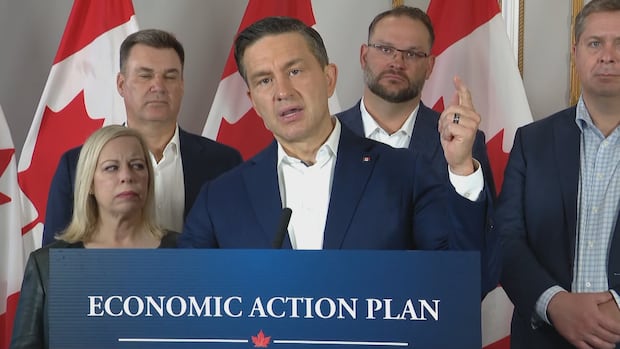
When questioned at a news conference about his support for the federal government’s planned counter-tariffs on the U.S., Conservative Leader Pierre Poilievre stated that Canadians need to understand the costs associated with the counter-tariffs for families and businesses, as well as what actions Prime Minister Mark Carney is taking to mitigate those costs.
Greer: Future of negotiations ‘depends on Canada’
During an appearance on Fox News on Sunday, Greer attributed the failure of the negotiations to Canada, asserting that the responsibility to revive talks lies with Ottawa’s leadership.
“They faced this deal directly and after a few days chose to walk it back,” he commented. “The future of these discussions depends on Canada. They are the ones who walked away and declared the suspension of negotiations.”
Carney has pointed to the collapse of discussions as a result of the U.S. suggesting “new terms that were uneconomic, unjust, and undermined the net advantages for Canada, casting doubt on the reliability of any agreement.”
He also mentioned that last-minute demands from the U.S. would have restricted Canada’s capacity to negotiate trade agreements with other nations or to safeguard the French language.
Nevertheless, Carney has indicated that Canada is open to returning to negotiations, provided the U.S. ceases its “shade-throwing” and begins to take the process of finalizing a trade deal seriously.
Trump has continued to express his discontent with Canada in the aftermath of the negotiations’ failure and in the lead-up to the recent escalation.
On Friday, the president threatened to cease all trade with Canada.
“To reduce our trade deficit with any country, we simply need to stop trading with them. Canada is one of those,” he stated to reporters in the Oval Office. “If we completely halt trade with Canada, we would save $90 billion. Keep in mind, they conduct nearly all their business with the United States, while we engage in a relatively minimal amount of trade with them.”
In a post on Truth Social on Sunday, Trump criticized Canada’s exchange rate with the U.S., labeling it “unacceptable.”
On Monday morning, he shared a map of North America, superimposing the Canadian, Mexican, and Greenlandic territories with the American flag, portraying the entire region as part of the United States.
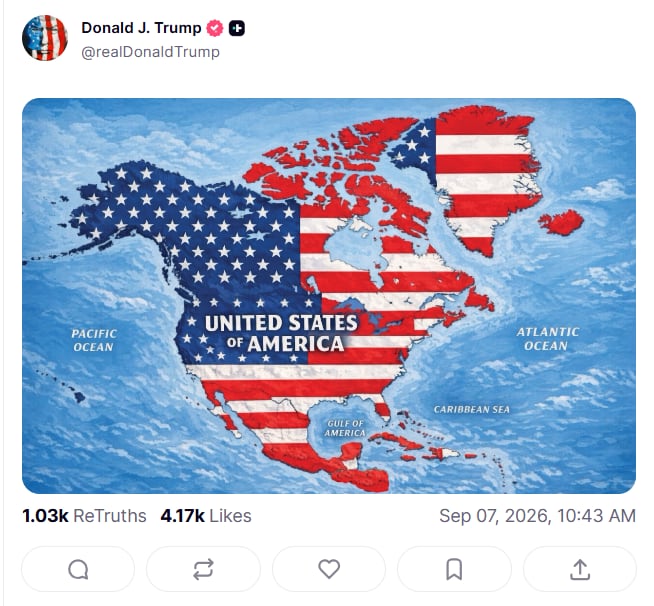
(U.S. President Donald Trump via Truth Social)
In another post on Monday, Trump targeted Bombardier, a Canadian aircraft manufacturer, stating that there should be “no more selling Bombardier in the United States.”
Trump noted that the firm generates over half of its revenue from the U.S., “while Canada restricts our GREAT American banks and companies throughout the U.S.A.”
Describing the situation as “entirely unjust and unfair,” Trump asserted that if Canada desires access to U.S. markets, it must produce in the U.S. and “stop treating America like a ‘piggybank.'”
Bombardier already has manufacturing operations in the U.S., with a defense division based in Kansas that prepares aircraft for specialized missions. Approximately half of the 5,100 aircraft operated by Bombardier’s customers are located in the U.S.