
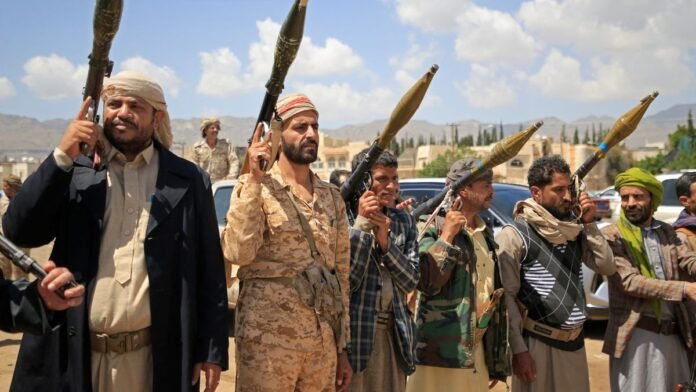

Iranian forces are believed to possess approximately 70% of their ballistic missiles from before the conflict, along with 60% of their launchers and a minimum of 40% of their drone supplies, as per recent intelligence analysis. This revelation of Tehran’s remaining lethal weaponry comes as Iran issues a warning that they still hold strategic “cards to play,” in response to concerns about potential escalation involving the Yemeni Houthis.
The escalating tensions in the region have sparked alarm ahead of the imminent expiration of the current two-week ceasefire on Wednesday. There are growing concerns that if the Houthis enter the conflict, they could potentially block the Bab el-Mandeb Strait, a vital route that has become crucial due to the blockage of the Hormuz passage.
Ali Abdollahi, the commander of Iran’s Khatam al-Anbiya Central Headquarters, the country’s wartime command center, asserted Iran’s military superiority. He emphasized that he would not permit Donald Trump to manipulate the situation with false narratives, amidst fresh warnings of possible new military actions by Iran.
Mohammad Bagher Ghalibaf, the Iranian parliamentary speaker expected to lead the delegation for peace talks in Pakistan, cautioned that they are ready to unveil new strategies on the battlefield. He reiterated Iran’s stance of rejecting negotiations with the US under threats, stating their readiness to reveal additional tactics in the ongoing conflict.
A UK intelligence report, reviewed by the Mirror, outlines the existing threat posed by Iran, stating that US intelligence assessments indicate Iran likely retains around 70% of its pre-conflict ballistic missiles and 60% of its missile launchers. The report also mentions that Iran still possesses about 40% of its drone arsenal. Yemeni Houthi officials have warned of the potential closure of the Bab el-Mandeb Strait if US President Donald Trump continues to impede peace efforts, highlighting the strait’s significance in global trade, especially for oil and fuel shipments.
A potential closure of the Bab el-Mandeb Strait due to the escalating tensions between the US and Iran could result in the second major trade route closure, following the Strait of Hormuz. Speculations suggest that US Vice President JD Vance may travel to Pakistan to seek peaceful resolutions with Iran.
The distrust between the two nations has deepened, with Iran expressing concerns about past attacks during peace negotiations, fearing that talks could serve as a cover for further military actions. Iran’s High Council for Human Rights has strongly condemned US attacks on religious and cultural sites in Iran, accusing the aggressor regimes of attempting to eradicate symbols of religious minorities.
The condemnation included alleged strikes on the Tehran Jewish Synagogue, the Nicholas Orthodox Cathedral, and St Mary Greek Orthodox Church, portraying a deliberate effort to erase the cultural identity of religious minorities in Iran.