
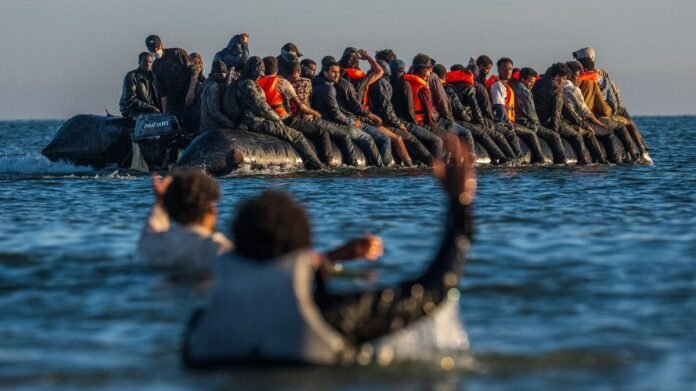

More police officers will be deployed to monitor beaches in Northern France to prevent small boat crossings following the finalization of a new agreement. Drones and helicopters worth millions of pounds will be utilized for surveillance to deter smugglers from loading unsafe vessels with migrants. The deal includes a 40% increase in officers tasked with intercepting small boats in France, with the UK emphasizing that funding will be contingent on achieving results.
Payments will now be linked to reducing the number of individuals reaching the UK, with the current deployment of 750 police, intelligence, and military personnel along the French coastline set to increase to 1,100 under the terms of the agreement. This development comes after a prolonged impasse, during which Home Secretary Shabana Mahmood advocated for enhancements to a previous arrangement negotiated by the Tories.
The agreement entails an investment of £500 million to enhance enforcement efforts, with an additional £160 million earmarked for successful measures. However, advocates caution that solely focusing on policing the Channel may not be sufficient, advocating for the expansion of safe pathways as a more effective strategy to combat smuggling networks.
In a statement announcing the accord, Keir Starmer stressed the necessity of restoring order and control to borders by cracking down on perilous crossings and prosecuting human traffickers. The collaboration with France has already thwarted tens of thousands of attempted crossings, with nearly 60,000 individuals without legal status deported or returned by the government.
As part of the agreement, a new riot police unit will be established to manage unruly crowds on beaches, while a French intelligence unit’s size will nearly double from 18 to 30 officers. Efforts will also concentrate on targeting taxi boats that pick up migrants in shallow waters, with French authorities assigning an additional 20 maritime officers and a new vessel for interception operations.
Since the beginning of the year, at least six fatalities have been recorded in attempted Channel crossings, with over 6,000 individuals successfully reaching the UK since January 1. Home Office data reveals that over 42,000 individuals attempting Channel crossings have been intercepted since July 2024, when the Labour party assumed power, resulting in the arrest of 480 suspected traffickers last year.
Under the previous agreement signed during Rishi Sunak’s premiership in 2023, the UK committed to paying France £476 million over three years to curb small boat crossings, with an interim £16 million arrangement agreed upon earlier this year pending the finalization of updated terms. Shabana Mahmood emphasized the effectiveness of collaborative efforts with France in preventing illegal migration attempts and commended the landmark deal for curbing dangerous journeys and holding smugglers accountable.
The influx of officers associated with the agreement will be front-loaded to coincide with the peak period of small boat crossings in the summer. The Home Secretary is spearheading a series of measures aimed at dissuading migrants from entering the UK, including implementing 30-month reviews of refugee status that could lead to repatriation if deemed safe.
Furthermore, the government is exploring incentives for failed asylum seekers, including families, to depart the UK voluntarily. However, critics argue that the government’s emphasis on policing the Channel addresses only symptoms rather than root causes, warning that insufficient safe and legal migration pathways may drive individuals to undertake hazardous small boat journeys.
Imran Hussain of Refugee Council highlighted the importance of safe routes, emphasizing that many migrants seek refuge in the UK due to existing ties or affiliations, while Sile Reynolds from Freedom from Torture criticized the perceived brutality of UK-funded enforcement measures against vulnerable individuals seeking safety from conflict and persecution in countries like Eritrea, Afghanistan, Iran, Sudan, and Somalia.