
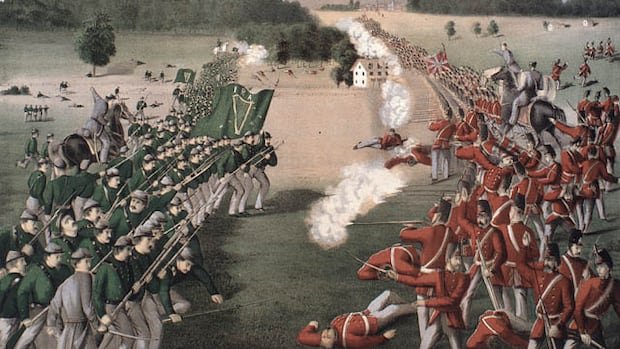

An unfamiliar clash that unfolded on Canadian land just a year prior to Confederation might not resonate widely in the historical memory of Canadians beyond the vicinity of Fort Erie, Ont., yet it holds significant historical importance. The 1866 Battle of Ridgeway, also known as Limestone Ridge, marked the first instance where Canadian troops, under the command of Canadian officers, engaged in combat. This event also served as the inspiration for Decoration Day, a precursor to Remembrance Day, which is still commemorated annually in certain regions of the country.
Despite the historical significance of the battle, the names of the nine individuals who lost their lives in the conflict are notably absent from the Books of Remembrance, an assembly of eight volumes housed on Parliament Hill that enlists the names of soldiers who made the ultimate sacrifice in service to Canada. A fresh petition, scheduled for presentation in the House of Commons, seeks to include these nine individuals, along with the numerous others who perished in the aftermath of the battle, in the official list.
Conservative MP Fred Davies, who represents the Niagara South riding encompassing Fort Erie, where the battle unfolded, emphasized the importance of acknowledging those who sacrificed their lives in defense of Canada. Davies expressed his personal connection to the site of Limestone Ridge, underscoring the need for national recognition of the historical event.
The Battle of Ridgeway was not a resounding victory for the Canadian forces. Inexperienced volunteers faced off against Fenian raiders, many of whom were veterans of the American Civil War. The Fenian Brotherhood, an Irish American movement advocating for Irish independence from British rule, sought to achieve their goal by invading and occupying parts of British North America, intending to negotiate with Britain for Irish independence.
In 1866, a group of raiders crossed the Niagara River with the intention of targeting the Welland Canal, encountering around 800 Canadian volunteers from various regiments at Limestone Ridge near Ridgeway and Fort Erie. Historian Peter Vronsky, author of the book “Ridgeway: The American Fenian Invasion And The 1866 Battle That Made Canada,” praised the swift mobilization of hundreds of Canadians from the Golden Horseshoe region. However, he noted that the Canadian troops were ill-equipped for what he described as Canada’s inaugural modern battle, lacking essentials such as food rations, water, appropriate footwear, and ammunition.
Despite engaging the invaders in combat and exchanging fire, the Canadian forces eventually dispersed in a disorderly retreat following a Fenian bayonet charge. Nevertheless, the Fenian incursion was thwarted, leading to their retreat back to the American side of the Niagara River.
While acknowledging the battlefield defeat at Ridgeway, Davies emphasized that the valor and sacrifice of those who perished should not be discounted. He highlighted the importance of honoring those who fought to protect Canada from invasion, regardless of the organizational shortcomings and lack of preparation.
The memorial erected in honor of the nine fallen soldiers at Ridgeway in 2016 stands as a testament to their legacy. Fort Erie Mayor Wayne Redekop expressed the town’s longstanding efforts to have the names of the fallen soldiers included in the Books of Remembrance, citing their significant contributions to shaping Canada’s identity.
Despite occurring before the formal establishment of Canada, the names of soldiers who perished prior to Confederation, including those in the War of 1812, are included in the Books of Remembrance. Redekop, Davies, and Vronsky all contended that the Battle of Ridgeway had a direct impact on the formation of Confederation, prompting previously hesitant individuals to unite for a common cause.
Several regiments that participated in the 1866 battle, such as the Queen’s Own Rifles and the Royal Hamilton Light Infantry, continue to exist today. Vronsky emphasized that the battle served as a pivotal moment in testing and shaping Canada’s modern armed forces.
Alexander Muir, the composer of “The Maple Leaf Forever,” composed the patriotic song following his involvement in the Battle of Ridgeway. While it is believed that Muir drew inspiration from a silver maple tree in Toronto’s Leslieville neighborhood, Vronsky suggested that Muir’s inspiration may have stemmed from the maple leaf emblem of the Queen’s Own Rifles, the regiment he fought alongside during the battle.
In conclusion, the Battle of Ridgeway, though not a decisive victory, played a crucial role in shaping Canada’s military history and national identity, underscoring the bravery and sacrifice of those who defended their homeland.