
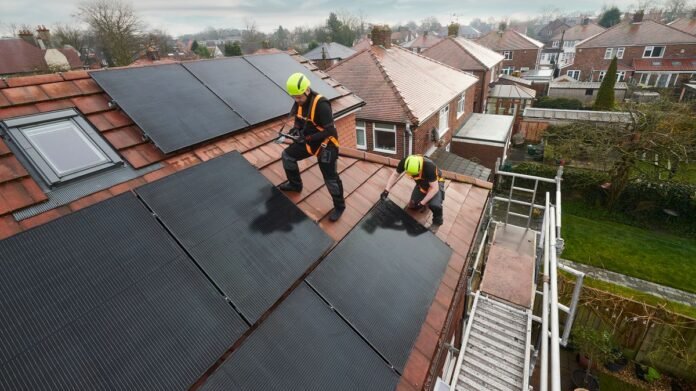

The government is increasing a grant for upgrading boilers due to an energy crisis sparked by the Iran conflict. Energy Secretary Ed Miliband is set to boost the grant by an additional £100 million to reduce energy costs for individuals in social housing. Additionally, £25 million will be allocated to assist low-income households in obtaining plug-in solar panels.
The initiative will also promote the expansion of solar energy on public properties and encourage the transition to electric vehicles. This move comes as households and businesses are concerned about escalating energy expenses caused by the turmoil in the Middle East.
Advocates emphasize the importance of decreasing the UK’s reliance on fossil fuels and promoting renewable energy sources to shield the country from global disturbances.
Critics argue that achieving net zero emissions entails substantial initial expenditures, with pressure on the Labour party to permit more drilling for North Sea oil.
Mr. Miliband will underscore Labour’s commitment to net zero emissions in an upcoming speech, announcing an increase in the grant under the Boiler Upgrade Scheme from £7,500 to £9,000. The scheme is targeted at households using heating oil or Liquefied Petroleum Gas (LPG).
The scheme enables households in England and Wales to replace their gas boilers with heat pumps, a form of eco-friendly heating that harnesses heat from the air or ground. However, the costs and modifications to existing radiators have deterred many from adopting this technology.
The grant increase aims to bridge this financial gap. Without the grant, a heat pump costs around £9,300, but with the grant, the expense reduces to £1,800, according to the Department for Energy Security and Net Zero.
Further announcements include an extra £100 million for the Social Housing Fund to finance 57,000 rooftop solar panels for households this fiscal year. The government is already investing £1.2 billion to upgrade 100,000 social homes over the next two years, with an additional 100 schools benefiting from new rooftop solar installations this year.
Mr. Miliband stated, “We are advocating for the people during this crisis. Our decisions led to a £117 reduction in the energy price cap in April, with ongoing savings until the end of June.”
He added, “To safeguard families in the long term, we must accelerate the electrification of Britain and reduce our exposure to unpredictable fossil fuel markets. Therefore, we are enhancing support for individuals in social housing and rural areas to upgrade their homes and lower their bills as we progress towards clean, domestically sourced energy.”
Simon Francis, from the End Fuel Poverty Coalition, highlighted the impact of global gas market fluctuations on household energy expenses, particularly for those in fuel poverty. He emphasized the need for support to invest in energy efficiency measures.
Angharad Hopkinson, a political campaigner for Greenpeace UK, commended the government’s effort to reduce reliance on volatile fossil fuels and regain control of the energy sector.
Pranesh Narayanan, a senior research fellow at IPPR, supported the transition to net zero as crucial for shielding the UK from energy price spikes driven by international conflicts. He noted that alternative energy sources like solar and wind are not affected by geopolitical disturbances.
In conclusion, the government’s push towards cleaner energy solutions is seen as a vital step in securing the country’s energy future amidst global uncertainties.