
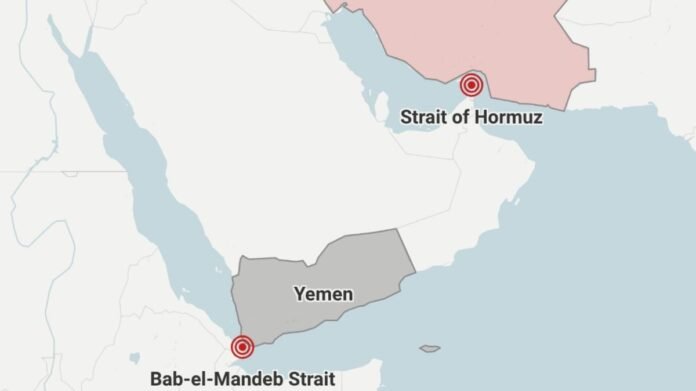

Concerns over rising living costs due to tensions between the United States and Iran have escalated, with the Iranian government considering shutting down a key waterway, potentially causing significant economic harm to Western nations.
The uncertainty surrounding the status of the Strait of Hormuz, a vital trade route controlled by Iran, has led to persistent high prices of crude oil and related products like gasoline. As talks for a peace agreement resume in Islamabad, the leaders of both countries are displaying their strength.
Iran’s leverage lies in its control of the Hormuz strait and the Bab el-Mandeb Strait, known as the “Gate of Tears,” which serves as a crucial alternative route.
While the Hormuz route remains closed, the Bab el-Mandeb Strait is being utilized for shipping, seeing a high volume of daily vessel traffic. Unlike the Hormuz strait, Iran lacks direct authority over this alternate passage, located thousands of miles away off the Yemeni coast.
Control of the Bab el-Mandeb Strait rests with Iran-aligned Houthi rebels, who have threatened to block the passage, as per a UK intelligence report revealed by the Mirror.
The report highlights Iran’s possession of ballistic missiles and drones, emphasizing the significance of the alternative strait. It states that US intelligence estimates indicate Iran retains a substantial portion of its missile and drone arsenal despite previous conflicts.
A senior Houthi official has cautioned that the Bab el-Mandeb Strait could be closed if US President Donald Trump continues to impede peace efforts, underscoring the strait’s vital role in global trade, especially for oil and fuel shipments between the Gulf region, Europe, and Asia.
Yemeni officials have acknowledged the strait’s strategic importance, with potential plans to close it if the conflict escalates, a move that experts warn could have severe repercussions on the world economy, especially for major oil-exporting countries.
Noam Raydan, a senior fellow at The Washington Institute for Near East Policy, highlighted the economic risks of a strait closure similar to the Hormuz crisis, stressing the potential impact on regional economies reliant on the passage for oil exports.
The closure would disrupt commodity movements through critical chokepoints in the region, further straining the global economy and trade routes.